
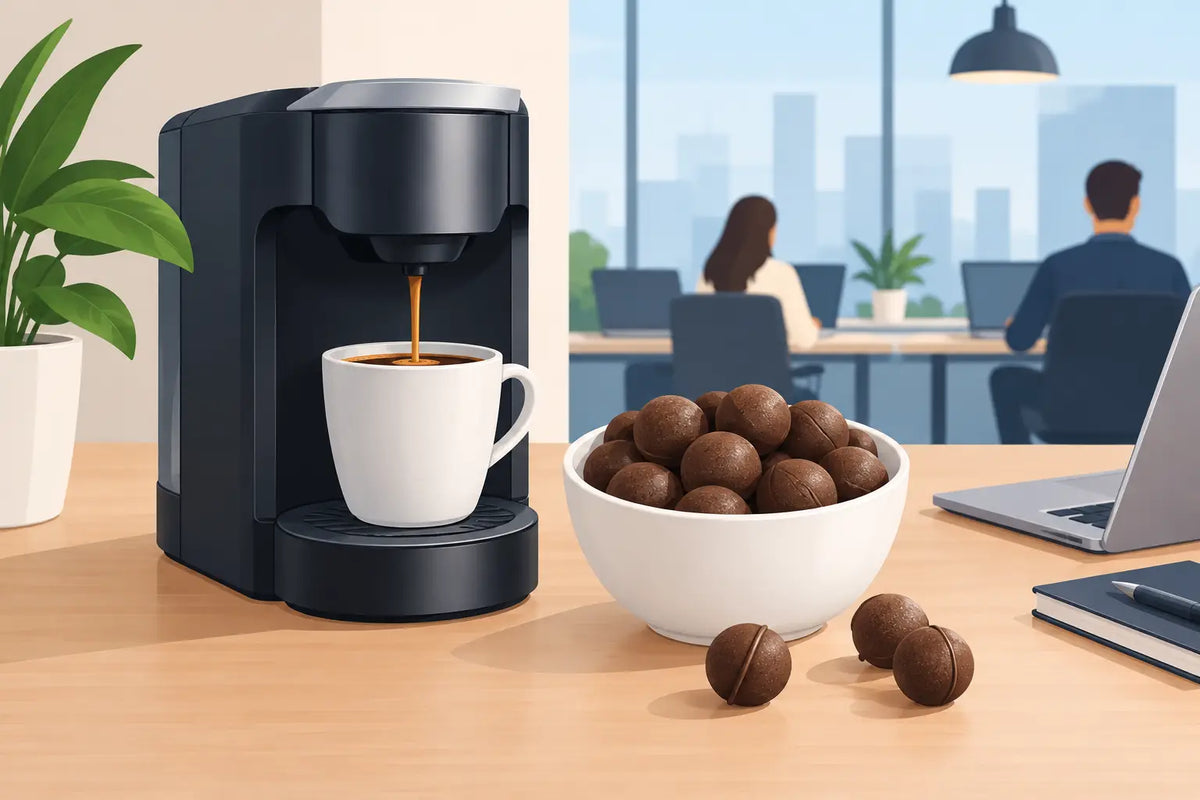
A busy office coffee point has two jobs: make a reliable drink quickly and avoid creating another task for facilities staff. Coffee balls for office machines can meet both requirements in the right setup, providing pre-portioned ground coffee without the loose grounds, grinding noise, or capsule storage associated with some alternatives. They are not, however, a universal replacement for beans, capsules, or traditional commercial espresso equipment.
The decision starts with the machine. Coffee balls are designed for compatible brewing systems and cannot be used in a standard bean-to-cup machine, espresso machine, pod brewer, or commercial filter coffee unit unless that machine is specifically built for them. For an office, that compatibility check matters more than the format's convenience claims.
What coffee balls are designed to do
Coffee balls are compact, pre-measured portions of roasted and ground coffee enclosed in a protective outer layer. A compatible machine recognizes the portion, brews it automatically, and ejects the used coffee ball into a collection container. The goal is straightforward: consistent dosing with a cleaner workflow than loose coffee grounds.
For staff, the process is simple. Insert a coffee ball, select the drink volume, and remove the cup when brewing is complete. There is no weighing, grinding, tamping, or knocking out a portafilter. That makes the format particularly relevant for small teams, meeting rooms, reception areas, and workplaces where nobody is assigned to operate coffee equipment.
The trade-off is choice. A bean-to-cup machine can offer a broader selection of beans and may be better suited to higher daily volume. A traditional espresso setup offers more control over recipe, grind, and milk texture, but it requires trained users and regular cleaning. Coffee balls sit between those options: lower-skill operation with a more coffee-forward format than many conventional single-serve systems.
Are coffee balls for office machines the right fit?
The best answer depends on daily demand, drink expectations, and who will look after the machine. Coffee balls work well where users mainly want black coffee or espresso-style drinks with minimal input. They can be a sensible choice for offices that value consistent portions, straightforward restocking, and a tidy counter.
They may be less suitable for a large office with continuous peak-time demand. If dozens of employees queue for drinks at the same time, a high-capacity commercial machine with a large water supply, bean hopper, and milk system may be more practical. The same applies to hospitality settings where a full café menu, multiple milk choices, or barista-quality espresso is expected.
Before selecting any system, estimate usage honestly. Count average drinks per day, but also identify the busiest 30-minute period. A machine that appears adequate on a daily total can still become a bottleneck at 9 a.m. or after a meeting ends. Water access, counter space, electrical supply, waste capacity, and milk requirements should be checked at the same time.
Compatibility is non-negotiable
Do not buy coffee balls based on size or appearance alone. Their format is machine-specific. They are not compatible with Sage or Breville espresso machines, Lelit machines, bean-to-cup machines from WMF or Saeco, or standard capsule machines unless the manufacturer explicitly confirms compatibility.
This is where offices can avoid unnecessary waste and downtime. Match the consumable to the exact machine model, then confirm that the machine's recommended drink sizes, cleaning steps, and waste-bin capacity fit the intended use. If a workplace is replacing an existing machine, it may be more cost-effective to select consumables that suit that installed equipment rather than change formats entirely.
What the office experience looks like
A good office coffee setup should be intuitive for first-time users. Coffee balls reduce the number of variables: the dose is predetermined, and users do not need to adjust a grinder or handle loose grounds. That consistency is useful in shared spaces, where one person may want a short coffee and the next may simply need a larger cup before a client call.
The machine still needs daily attention. Used coffee balls collect in an internal container, drip trays fill, and water tanks need refilling if the unit is not plumbed in. Milk-based drinks add another level of care. If the machine uses a fresh-milk system, staff must follow the manufacturer's cleaning routine every day. Coffee balls simplify coffee preparation, but they do not remove the need for hygiene and maintenance.
For offices with no dedicated facilities team, assign a named person or rotate basic checks. A quick daily routine usually includes emptying the grounds container, rinsing the drip tray, checking water, wiping the dispensing area, and confirming that enough coffee balls are available. Keep the machine's approved cleaning products close by rather than substituting household cleaners, which can damage components or leave residues.
Cost, storage, and waste considerations
Per-cup cost is usually higher for portioned coffee than buying whole beans in bulk. In return, an office gains predictable portions, easier inventory control, and less waste from stale open bags or incorrect dosing. Whether that premium is worthwhile depends on how much the team values convenience and consistency.
Storage is generally simple. Keep coffee balls in a cool, dry cupboard away from direct sunlight, strong odors, and humidity. Purchase quantities that match realistic consumption rather than overstocking. Freshness still matters, even when coffee is individually portioned.
Waste handling should be discussed before installation. Coffee balls are intended to reduce reliance on conventional aluminum or plastic capsule formats, but local disposal options and product-specific instructions still matter. The office should know where used portions go, how often the collection bin must be emptied, and whether any disposal route is available through the building or local waste provider. Never assume that every coffee portion can be handled in the same way.
Choosing the machine around the workplace, not the trend
A coffee format should support the way people work. A small design studio may prioritize quiet operation and a compact footprint. A corporate reception area may need a machine that looks professional and requires almost no explanation. A large office may need rapid output, multiple beverage recipes, and a service plan that prevents extended downtime.
For premium equipment, after-sales support is part of the purchasing decision. A machine that is easy to use still needs descaling, cleaning, periodic inspection, and prompt repair when a fault occurs. In the UAE, Perfetto After Sales can support equipment ownership through compatible consumables, care products, specialist service, and collection and delivery for eligible repairs.
Questions to answer before ordering
Ask the supplier or facilities team whether the machine is designed specifically for coffee balls, how many drinks it can make during peak demand, and what its daily cleaning routine involves. Confirm the size of the water tank and used-coffee container, particularly if the machine will not have a direct water connection.
Also consider beverage preferences. If most employees drink americanos or black coffee, a coffee-ball system may be a clean and efficient answer. If the office expects flat whites, cappuccinos, hot chocolate, decaf options, and different strength settings throughout the day, compare the available menu carefully against a commercial bean-to-cup alternative.
Finally, plan replenishment before the first delivery arrives. Keep enough coffee balls on hand to cover normal use plus a short buffer for busy weeks, but avoid turning the office cupboard into long-term storage. The best office coffee setup is the one employees can use confidently, the team can maintain easily, and the business can keep running without interruption.