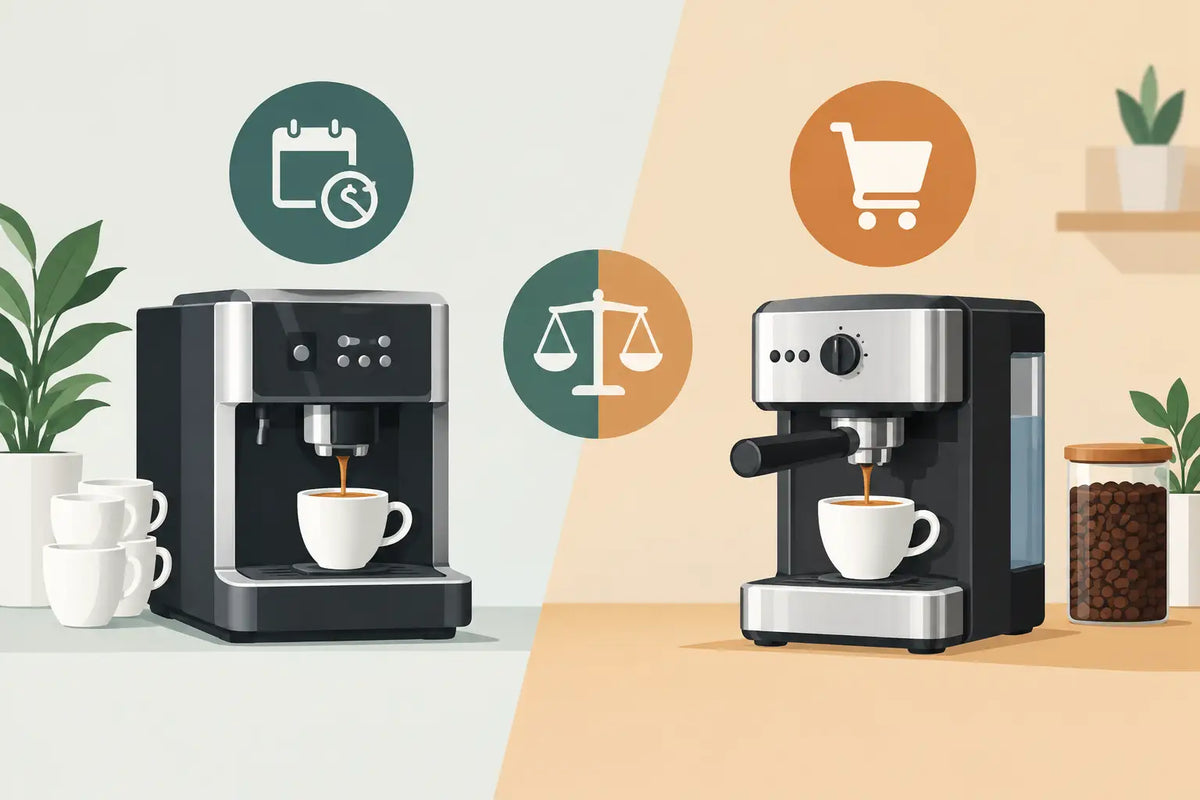
A machine that cannot keep up with the morning queue costs more than its monthly payment. For offices, cafés, and hospitality venues, rental versus buying coffee machines is a decision about reliability, capacity, service access, and cash flow - not simply the sticker price.
The right option depends on how much coffee you serve, how predictable demand is, who is responsible for cleaning and maintenance, and whether you need the flexibility to upgrade. A compact bean-to-cup machine for a 15-person office has very different requirements from a hotel breakfast station or a busy café counter.
Rental Versus Buying Coffee Machines: The Main Difference
Buying gives your business ownership. You pay upfront or finance the equipment, choose the model that suits your operation, and keep it for as long as it remains productive. Once the machine is paid for, your ongoing costs are coffee, milk, water filtration, cleaning supplies, replacement parts, and service.
Renting spreads access to commercial equipment across a fixed monthly payment. It can reduce the initial financial commitment and may include selected service support, depending on the agreement. Rental is often useful when a business needs a professional machine quickly, wants clearer monthly budgeting, or expects its requirements to change.
Neither route automatically includes every operational cost. Before comparing monthly figures, confirm what is covered: installation, staff training, preventive maintenance, call-outs, parts, replacement equipment, water filters, cleaning products, grinder support, and consumables. A low rental fee with limited service coverage can be less economical than it first appears. Equally, a purchased machine without a maintenance budget can create unwelcome downtime later.
When Renting Makes Practical Sense
Rental is usually strongest when protecting working capital matters more than building a long-term asset. A new office, seasonal venue, pop-up concept, or growing hospitality operation may not want to commit a large amount to equipment before coffee volumes are proven.
It also suits businesses that value predictable expenditure. Rather than making a substantial upfront purchase, you can plan for a known monthly cost. That can simplify approval for workplace amenities, executive coffee stations, meeting-room service, or guest-facing self-service points.
Flexibility for changing demand
Coffee demand rarely stays static. An office may add staff, a hotel may increase occupancy, or a café may introduce a second service point. If your rental arrangement allows upgrades, changing to a higher-capacity machine can be simpler than selling owned equipment and starting again.
This matters particularly with automatic commercial machines. A model such as the WMF Peak 50 or WMF 1100S can be suitable where speed, menu variety, and consistency are priorities, but the right specification still depends on actual drink volume, peak demand, milk requirements, and available counter space.
Lower exposure to early equipment issues
Commercial coffee machines are hardworking appliances with pumps, boilers, grinders, brew units, seals, valves, electronics, and milk systems that need regular care. A rental agreement with meaningful maintenance terms can give nontechnical teams a clearer route when a fault occurs.
Read the service conditions closely. Ask about response times, whether labor and parts are included, what happens if the machine is out of service, and whether misuse or inadequate cleaning affects coverage. Service support is valuable only when responsibilities are clearly defined.
When Buying Is the Better Investment
Buying is often the more cost-effective option for established businesses with stable demand and a clear equipment plan. A commercial machine can remain productive for years when it is sized correctly, installed with appropriate water treatment, cleaned daily, and serviced by qualified technicians.
The economics improve over time. While the upfront cost is higher, an owned machine does not carry a rental payment indefinitely. For a venue that expects to use the same machine over several years, ownership may deliver a lower total cost than a long rental term.
Full control over the setup
Ownership gives you greater choice over the machine, grinder, accessories, filtration system, and workflow. A specialty café may need a traditional espresso machine paired with commercial grinders, specific portafilters, precision baskets, and a dedicated water recipe. A corporate pantry may instead prioritize a fully automatic machine with simple drink selection and easy cleaning programs.
This control also applies to the service strategy. You can choose when to schedule preventive maintenance, keep common wear items available, and use compatible cleaning products and filters from the start. That approach reduces avoidable faults and supports more consistent coffee quality.
Residual value matters
An owned machine is not worthless at the end of its first use cycle. Well-maintained premium equipment may retain resale value, particularly when its service history is documented and it has been cared for with suitable parts and cleaning products. This will not recover the full purchase price, but it can improve the overall ownership calculation.
For smaller operations, pre-loved commercial or premium domestic equipment can also be a sensible route. Condition, usage history, parts availability, and serviceability should carry more weight than a tempting price alone.
Compare Total Cost, Not the Monthly Payment
The most useful comparison is total cost of use over the period you expect to operate the machine. For rental, include the monthly fee, deposits, delivery or installation charges, consumables, service exclusions, and any fee for ending early. For buying, include the machine price, finance charges if applicable, installation, filtration, planned maintenance, repairs, cleaning products, and likely resale value.
A simple three-year comparison can reveal the difference. If a rented machine costs a fixed monthly amount but includes preventive maintenance and parts, that certainty may justify the premium for an office without an equipment manager. If a purchased machine has a lower three-year cost and your business can fund proper upkeep, ownership may be the stronger financial choice.
Do not overlook downtime. A machine that stops working during a breakfast rush, a client meeting, or a busy lunch service affects staff time, customer experience, and revenue. The value of fast, specialist support should be part of the calculation, especially for high-volume locations.
Service, Water, and Cleaning Are Non-Negotiable
Whether you rent or buy, daily cleaning is not optional. Milk systems require careful hygiene, coffee oils build up in brew components, and scale can damage boilers and valves. Using the correct cleaning tablets, milk cleaner, water filters, and descaling products helps protect both the equipment and the quality in the cup.
Water deserves special attention in the UAE. Mineral content can accelerate scale buildup, so an appropriate filtration plan should be specified alongside the machine. A commercial machine may appear to have a technical fault when the underlying issue is poor water treatment or missed cleaning cycles.
For owned equipment, arrange service with a provider that understands the specific machine category and can access suitable parts. Perfetto After Sales supports commercial and premium coffee equipment throughout the UAE, making collection, repair, maintenance products, and compatible parts easier to manage from one specialist source.
Questions to Ask Before You Commit
Start with volume. Count not only average drinks per day but also the busiest 30-minute period. A machine that produces 80 drinks over a full day may still struggle if 35 employees use it immediately after a meeting ends.
Then consider drinks and users. Do you need espresso-based beverages, fresh milk, dairy alternatives, hot chocolate, or decaf? Will trained baristas operate the equipment, or does it need to be intuitive for every employee or guest? Finally, assess the site itself: water access, drainage, electrical capacity, counter space, ventilation, and daily cleaning responsibility all affect which model is appropriate.
A rental can be the sensible starting point when your needs are still moving. Buying becomes more compelling when demand is established and you are prepared to maintain the machine as a long-term business asset. Choose the option that keeps coffee service dependable at your busiest moment, then support it with the right filtration, cleaning routine, and technical care.